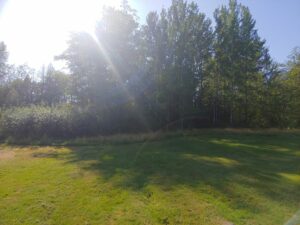
The organism that I plan to study is the Trembling Aspen Populus tremuloides , found in a pure stand on the west side of my study area. The Aspen tree is found throughout the province of BC and grows best in moist, well-drained soils. It produces root suckers that grow into clones that become a colony over time(British Columbia, n.d.). The Trembling Aspen prefers to grow in full sun as it is intolerant of shade.
My study area is an open field in a Regional Park that is surrounded by forest. These Aspen trees are comprised of a pure stand that is of mixed age and are located in a small area approximately 150m by 200m in size. There are a variety of different diameter sizes and height differences in the stand of trees, the larger of them are further west, deeper into the forested area, whereas the smaller trees are found closer to the open field. The soil was compact throughout the stand but was drier at the north end and moist at the south end. It appeared that there was a higher density of smaller diameter trees at the south end, closest to the open field.
Since the Trembling Aspen is shade intolerant, the new suckers and clones will likely survive best if they grow in the full sun, closer to the open field then under the dense forest canopy. Also, since the soil appeared to be more moisture on the south end, perhaps this is also a limiting factor to new tree growth. I predict that within the Trembling Aspen stand there will be a gradient, a higher abundance of younger trees (smaller trunk diameter) closer to the field and south and lower (larger diameter) as I move inward to the forest and north.
The response variable is the size / age of the Aspen trees (diameter of trunk) and the explanatory variable would be the availability of sunlight and soil moisture. Both the response and explanatory variables would be continuous.

I like the hypothesis for this study. Showing that a reproduction gradient exists in correlation to the amount of sunlight is interesting. Does the aspen stand have exposure on all sides? A northern vs. southern exposure should show different gradients if your predictor variable is truly the predictor.
I would exercise caution using the size of the tree as an indicator of age. I would imagine that, if the conditions are favorable, the tree may be bigger for its age compared to a tree in unfavorable conditions.
Are you using an instrument for the light level and soil moisture? If so, what kind?
Sounds like your thinking is coming along. I think your hypothesis is in this post just not succinctly stated. Remember your hypothesis will contain the pattern and the process (pattern of aspen and what process is contributing) and the prediction is what you will test – your prediction is pretty good, maybe work on the wording a bit. It can be helpful to compare your hypothesis and prediction to the one in the Moodle tutorial and see if they follow the same kind of thinking.
Wonderful blog post and what an interesting study! I ‘m very interested in your prediction, as it is clearly stated and I know what question you are setting out to answer. With regards to pieces and patterns, I can see that you are using the trembling aspen as your pieces and the age of the tree in relation to the field as your pattern.
I understand your hypothesis, though it may have been a bit easier to isolate if it was clearly stated (e.g. “My hypothesis is…”). I believe that your predictor and response variables seem like they could be easily measurable in your field setting, especially because they are both continuous variables.
As for confounding variables, I wonder if there is a difference in nitrogen availability in the North vs South end (e.g more nitrogen in the South end allowing for new tree growth)?
All in all, this is a fascinating study and I’m excited to see the results!