In the Virtual Forest tutorial, using Distance-based sampling methods:
Table 1. Comparison of three distance-based sampling strategies; actual, random, and haphazard used to calculate the abundance of seven tree species (Eastern Hemlock, Sweet Birch, Yellow Birch, Chestnut Oak, Red Maple, Striped Maple, and White Pine) in the Snyder- Middleswarth Natural Area.
|
Tree Species |
| Strategies |
Eastern Hemlock |
Sweet
Birch |
Yellow
Birch |
Chestnut
Oak |
Red
Maple |
Striped
Maple |
White Pine |
Est. Time to sample |
| Actual |
469.9 |
117.5 |
108.9 |
87.5 |
118.9 |
17.5 |
8.4 |
|
| Systematic |
277.3 |
109.6 |
70.9 |
38.7 |
90.3 |
45.1 |
12.9 |
4hr 18min |
| % error |
40.99 |
6.72 |
34.89 |
55.77 |
24.05 |
157.71 |
53.57 |
|
| Random |
441.8 |
144.1 |
105.6 |
115.2 |
86.4 |
28.8 |
0.0 |
4hr 40min |
| % error |
5.98 |
22.64 |
3.03 |
31.66 |
27.33 |
64.57 |
100 |
|
| Haphazard |
485.0 |
121.2 |
83.9 |
93.3 |
74.6 |
18.7 |
18.7 |
4hr 38 min |
| % error |
3.21 |
3.15 |
22.96 |
6.63 |
37.26 |
6.86 |
122.6 |
|
Based on findings from Table 1:
Which technique had the fastest estimated sampling time?
The times between the 3 sampling strategies were somewhat similar, with the fastest strategy by ~20 minutes being the systematic approach in regards to sampling 24 plots.
Comparing the % error of the different strategies for the two most common and two rarest species. For each species the most accurate strategy was as follows:
- Eastern Hemlock (most common species) most accurate strategy: Haphazard
-
- It surpasses the random strategy with an % error of 3.21.
- Than random & haphazard strategies were more accurate than the systematic, as the systematic had an % error of 40.99.
- Red Maple (second most abundant species) most accurate strategy: Systematic
-
- This strategy had a 24.05% error.
- White Pine (rarest species) most accurate strategy: Systematic .
- Even though it had a 53.57% error, it is far more accurate than the random & haphazard strategies with % errors of 100, and 122.6, respectively.
- Striped Maple (second least abundant species) most accurate strategy: Haphazard.
-
- This strategy had a 6.86 % error which is very low, especially when compared to 64.57% and 157.71% errors for Random and Systematic, respectively.
Did the accuracy change with species abundance?
When comparing all three strategies regardless of tree species, accuracy decreased as species abundance lowered. Therefore, I recommend that more samples than 24 need to be taken to increase accuracy. The majority of % error was inversely proportional to the actual species abundance (save for a few data points), regardless of the sampling strategy.
Was one sampling strategy more accurate than another?
Haphazard strategy had an average % error of 28.96, which is lower than that for Random & Systematic (36.46% & 53.39%, respectively) – there by being the most accurate sampling strategy in a forest terrain. The random strategy being the least accurate.

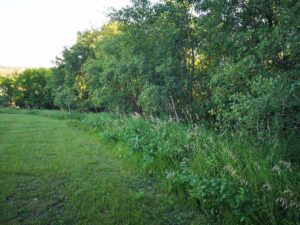 Border dividing the 2 areas of interest
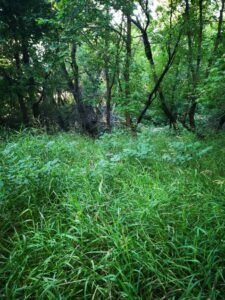 Forest Area
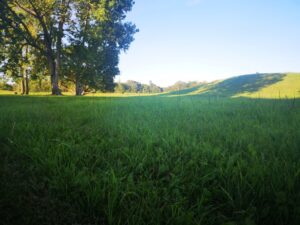 Hilly open grass area