Recent Posts

Blog Post 4- Sampling Strategies

Below are the results from the sampling strategies:

Sampling Method
Species Systemic Random Haphazard
Eastern Hemlock Estimated- 376.0 Estimated-429.2 Estimated- 532.0
Actual-469.9  Percentage Error-20% Percentage Error-8.5% Percentage error- 13.2%
Sweet Birch Estimated-136.0 estimated-116.7 Estimated-136.0
Actual-117.5 Perctage Error-15.7% Percentage error- .68% Percentage error- 15.7%
Yellow Birch Estimated-100.0 Estimated-120.8 Estimated- 92.0
Actual-108.9 Percentage error-8.17% Percentage error-10.9 Percentage error-15.5%
Chestnut Oak Estimated-88 Estimated-79.2 Estimated-88
Actual-87.5 Percentage Error-.57% Percentage Eroor-9.5% Percentage error-.57%
Red Maple Estimated-80 Estimated-100 Estimated-84
Actual-118.9 Percentage Error-32.7% Percentage Eroor-15.9% Percentage error-29.4%
Stripped Maple Estimated-0 Estimated-45.8 Estimated-20
Actual-17.5 Percentage Error-100% Percentage error- 161.7% Percentage error-14.3%
White Pine Estimated-0. Estimated-4.2 Estimated-8.0
Actual 8.4 Percentage Error-100% Percentage Error- 50% Percentage Error-4.8

The most accurate sampling technique for the most common species, the Eastern Hemlock, was the random sampling. The error percentage is roughly half that of the other techniques used. For the rarest species, the white pine, haphazard was the most accurate. The most efficient sampling technique in terms of time was systemic which took 12 hours and 34 minutes to complete. The others were not far behind that with random taking 12 hours and 48 minutes and haphazard taking 13 hours and 8 minutes to complete. My data showed that the abundance of trees, in general, impacted the accuracy of all methods. The less dense the trees, the more likely it is to have variations in the data. Twenty four points of sampling is not enough for this location. The trees spread out in a such a way that the results can be misleading. One area may have way more of one type of tree then other locations. To get a more accurate reading more sampling is needed and spread out in a way that all types of trees can be accounted for.

Blog Post 3. Ongoing Field Observations

The organism I am interested in is scentless chamomile (Tripleurospermum perforatum). Scentless chamomile is abundant on top, but is almost absent at the bottom of the pits.
My locations to record are:

1. On top of the mineral soil: Here the scentless chamomile is the most abundant and tall.

2. Mid-way down the slope: There is a steep decline in the abundance of scentless chamomile mid-way between the topsoil and the bottom of the pit.

3. The bottom of the pit: There is almost no scentless chamomile at the bottom of the pits.

I hypothesize that areas with abundant scentless chamomile will not be acidic. The explanatory variable would be pH (continuous) and the response variable would be scentless chamomile abundance (also continuous). I will measure the pH along the gradient to determine where it is high and where it is low and measure the abundance of the scentless chamomile to compare.

Post 1: Observations

Ecology refers to the scientific research of the relations that living organisms have with respect to each other and their natural environment. Fieldwork happened in the Acadia Research Forest (ARF) situated 20 kilometres northeast of Fredericton, New Brunswick, on Highway 10. This research forest was established in 1933 and continues to function as one of Canada’s essential and oldest research forest. The Acadia Research Forest is dedicated to facilitating continuing forest research or study through secure research sites. Additionally, the forest protects wildlife habitats and species that are at risk. I visited the Acadia Research Forest on 10th September and conducted field research at night and in the daytime. The potential subject that I want to explore for my research is Insect ecology and Natural history. Based on my observations, the interesting questions that may form the subject of the research project are:

  1. Why is it important to manage and conserve forest ecosystems?
  2. How are insects important in terrestrial biodiversity, particularly emphasizing on their excessive abundance and species richness?
  3. How to investigate the taxonomy and explore natural history and understand the functions or roles of the insects using observation methods in the field?

The identification of the insects and discovering their natural history as well as understanding their importance helps in creating awareness of the significance of the forest habitat conservation.

Blog Post 5: Design Reflections.

My initial data collection based on my strategy went well. Since day 1 the density of geese around the waterbodies was obvious and the areas that I chose to collect data from were fairly close to each other. As I was collecting data I noticed that the number of geese around the ponds were much higher than around the river, which was supporting my initial hypothesis. The difficulty in my sampling strategy was regarding replication, I was not sure how to do that. So, I decided to count the number of geese at the 6 locations I chose twice a day and to also record the weather to see if that affected the number of geese. I counted counted the geese 5m around the ponds and river spots because they were in groups.

I was surprised with the data because there were so many geese around the ponds which I did not expect. I collected data using this strategy for 15 days. I also thought about dividing the grassland around just one pond into 10 quadrats and count the number of geese in them but I was not sure if that would prove my hypothesis, since I wanted to compare the density around 2 kinds of waterbodies. I achieved replication by collecting data twice a day in 6 spots so I did not modify the strategy. I decided to go ahead with my initial strategy because I wanted variation and more data to prove my hypothesis.

Blog Post 2. Sources of Scientific Information

a) This is an online scientific article.

https://www.nature.com/articles/s41598-017-12462-9

b) It falls into the category of academic, peer-reviewed research material.

c) It contains a method and results section, references, acknowledgments, in-text  citations and was written by experts in the field.  The ‘scientific report’ website it was published by corroborates this and states that it only publishes peer-reviewed materials and shows the date received, accepted, and published on the article.


Batanero, G.L., León-Palmero, E., Li, L. et al. Flamingos and drought as drivers of nutrients and microbial dynamics in a saline lake. Sci Rep 7, 12173 (2017). https://doi.org/10.1038/s41598-017-12462-9

Blog Post 1: Observations

The area that I have selected to observe is the Garden City Land Teaching and Research Farm, currently leased by Kwantlen Polytechnic University (KPU) in Richmond BC. The land is primarily bog and open for citizens to walk. It also has 8 acres of farmland run by the Sustainable Agriculture Program of KPU. The specific location I chose is between the untamed bogland and the organically farmed production land. I have selected an area of large stretch of land on the southern side. This area is generally flat but has been specifically modified by the professors at KPU to do their ‘Greenhouse Gas Plot’ research project; this entailed digging down to the bog in segments and leaving other segments with the mineral soil layered top. There is a notable gradient between the two different plots. I visited October 19 at 16.00 during a cool and dry day, however the week prior saw heavy precipitation. I observed that there was a denser and more diverse group of plants closer to the peat.  I observed that the scentless chamomile was very abundant on the top soil and very scarce nearer the bottom of the pits, and that clover was prominent throughout but more abundant at the bottom of the pits.  overall, there was more abundance and diversity at the bottom of the pits.  I am not sure whether to focus on a specific plant or where there is more diversity.  Before I collect samples I will be mowing the site to simplify the observation of my sample group (TBD).

over time.

My three questions are:

Is there a correlation between the soil being disturbed and the success of new plants establishing?
Are the plants that are lower more successful due to the shade in the lower level? Or more water access?
Does the pH of the soil being closer to the peat land provide a more suitable environment for the success and diversity of plants?

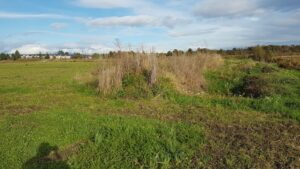
This is the farmland. The pits are along the right side of the photo.


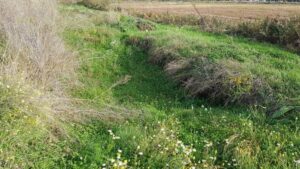
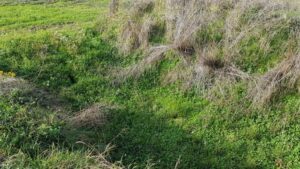
One of the pits. This picture shows the difference in scentless chamomile abundance at the top and bottom of the pit.

Blog Post 7: Theoretical Perspectives

The ecological process that underlies my research is reproduction. My hypothesis has changed somewhat throughout the process of gathering my data and literature review, but the main concept of seed pod production varying due to an environmental factor has remained the same. As factors like light availability and disturbance vary, the ability of a plant to thrive and reproduce should also vary. Too much disturbance and the plant fails to reach maturity as a result of being damaged, too little light and the seeds that do get produced may be infertile. A gradient should be identifiable between beneficial and detrimental conditions.

Keywords for my paper would be:  Dog strangling vine, follicle, disturbance.

Blog post 2: Sources of Scientific Information

The paper I have chosen is ‘Tree canopy cover constrains the fertility-diversity relationship in plant communities in plant communities of southeastern United States’. This paper has been written by professionals in the field and has gone through peer review as stated in the ‘Acknowledgements’ section of the paper. It also contains a method and result section showing the experimental data collected and different analyses done. In the discussion, the findings are compared to the past literature on the topic as shown by the in-text citations and there is a bibliography at the end of the paper.

Therefore, this paper is an academic peer-reviewed research article.

https://esajournals.onlinelibrary.wiley.com/doi/epdf/10.1002/ecy.3119 

Instructor: Robyn Reudink

Post 3

Blog#3

Field Research Project

Blog Post 3: Ongoing Field Observations

Create a blog post to document your ongoing field observations. Supplement your blog entry with scanned or uploaded examples from you field journal. Specific points you need to cover are:


  1. Identify the organism or biological attribute that you plan to study.

I plan to study poison ivy distribution in a disturbed habitat.


  1. Use your field journal to document observations of your organism or biological attribute along an environmental gradient. Choose at least three locations along the gradient and observe and record any changes in the distribution, abundance, or character of your object of study.


Location 1

meadow

Location 2

forested

Location 3

old field

Distribution none Clumped Clumped
Abundance 0 3 4
Character none Low growing some climbing


I visually broke up the area into three zones and followed a transect line along the edge of the trail. I recorded for 1 meter x 1metre plots just off the trail at the start of each zone. The meadow begins at the start of the trail. The forest begins at the same spot on the other side of the trail and the field begins where the forest thins and I can see the open field through the trees.


  1. Think about underlying processes that may cause any patterns that you have observed.


Other trails in the area, including one only approximately 0.5km down the road did not have any noticeable poison ivy present. This had originally led me to wonder if the heavy equipment presence had anything to do with the abundance on the trail I am researching.

I reviewed research indicating that poison ivy will grow well in disturbed areas, so that may be a factor in why it’s doing well on that trail (Admin, 2016). I still wondered however why the distribution of the poison ivy is concentrated on the left side of the trail, especially since the right side is more disturbed. I had thought that shade may be the factor, however my research indicated that poison ivy does well in both shade and sun, so I don’t think that is the main explanatory variable (Admin, 2016).

After completing the table above, I noticed that the plants tended to grow in clumps, rather than as individuals spread out. The clump in the forest location was growing amongst raspberry bushes and the field clump was climbing up a rock, near an apple tree. There were several species of birds including crows, chickadees, and woodpeckers that I noted. There are many mammals as well such as deer and chipmunks which I have encountered on other walks. According to Brown, several animals eat poison ivy and distribute seed. I am wondering if foraging sites like the apple tree and raspberry bushes will have a higher poison ivy concentration overall. This could be due to dropping seed while feeding (Diane Brown 2018). In fact, I saw a chickadee relieve itself while perched on a tree just a little further down the trail. Another place that I have noticed poison ivy is in the lot next to me. There is an apple tree there, which adds to my suspicion about a connection.


  1. Postulate one hypothesis and make one formal prediction based on that hypothesis. Your hypothesis may include the environmental gradient; however, if you come up with a hypothesis that you want to pursue within one part of the gradient or one site, that is acceptable as well.


My hypothesis is that wildlife may be spreading poison ivy when foraging.


One prediction is that poison ivy will be distributed more heavily near abundant forage sources like fruit shrubs and trees.


  1. Based on your hypothesis and prediction, list one potential response variable and one potential explanatory variable and whether they would be categorical or continuous. Use the experimental design tutorial to help you with this.


One potential response variable is concentrated poison ivy distribution. This is a numerical, continuous variable. We are trying to see how many plants are growing in certain areas.


One potential explanatory variable is abundant fruit/forage sources. This is categorical because it is a yes/no if present question.


References


Admin. Poison Ivy. Center for Agriculture, Food and the Environment. 2016 Oct 26 [accessed


2020 Oct 13]. https://ag.umass.edu/landscape/fact-sheets/poison-ivy


Brown D. Identifying poison ivy isn. [accessed 2020 October 14].


https://www.canr.msu.edu/news/identifying_poison_ivy_isnt_always_easy_to_do


Weaver MR, Abrahamson WG. Population/Community Biology : Community Sampling Exercise .


Population/Community Biology : Community Sampling Exercise. 0AD [accessed 2020 Oct 13].


http://www.departments.bucknell.edu/biology/courses/biol208/EcoSampler/

Blog Post 9: Field Research Reflections

Reflecting on the process of designing a field experiment and then carrying it out, I can say that it was very beneficial to my learning process. It wasn’t without some challenges though. I struggled to narrow down a pattern to observe and as a result chose an organism (fungi) that lead to a rather large experimental design. I needed to sample trees and this increased my study area vastly. I ran into some issues grasping sampling methods and procedures and I realized quite quickly, that the energy you put into planning while in the ‘office’ can make for an easy and seamless field visit. I had to return to the field as I had not pre-planned accordingly. I also realized that bias was throughout my study as it depends on the competence of the researcher (me) and my ability to comprehend sampling strategies and also species identification.

I found certain aspects of this process challenging, but I also learned what I could do better in the future. I found it really important to understand the way in which you preferentially learn. I really enjoy learning from another person in the field, rather than a document online. I believe that face-to-face teaching in the field for tree sampling would simplify the technical jargon I felt I was wading through in online procedures and literature. I did also appreciate that an online classroom took me outside, which is not common.

This process allowed me a much deeper and better understanding of the development of ecological theory. It’s one thing to ponder about the natural world, it is a completely different thing to engage in applied science to answer that question. My limited grasp of this, makes me believe that those who possess strong qualities for ecological theory, not only understand large concepts but can narrow down their thinking to minuscule interactions while being analytical thinkers and possessing much creativity.