Blog Post 3: Ongoing Field Observations

My third blog post comes with a bit of a delay, fortunate I did take notes on the last day of observations, as well as taking photographs of the evidence of the bog fire from last year.

Before proceeding, I’d like to direct the reader’s attention to an article from last year that reported on this fire, and it’s location. I would like to do this in order to provide verification of the bog fire, the time and location at which occured.

Year in review: Bog fire burned: Richmond’s wildfire was one of the biggest blazes in local history.
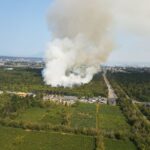
From the article:

“The summer of 2018 was one of the hottest ever recorded in B.C. and Friday, July 27 is a day that will live long in the memory of Richmond’s fire department.

Early morning reports of smoke coming out of the peat woodland at the DND Lands, near Westminster Highway and Shell Road, quickly developed into a wildfire.” (Campbell, 2018).

I’ve also been trying to determine how to demonstrate to the readers, here, that the burnt over areas I plan on sampling in did indeed experience that same fire a year ago. It occurred to me that in response to their canopies being destroyed by the fire, many of the invasive blueberry, Vaccinium corymbosum, would probably have begun to re-sprout this year. The new vegetative growth, if it was only from this years growth, should not have had time to lignify, so if I observe an abundance of such growth (all green, with no lignified, woody tissues present) then this should be a demonstrable indicator of a fire having occurred within the area of observation in the season prior(summer 2018) to this year’s growing season (2019).

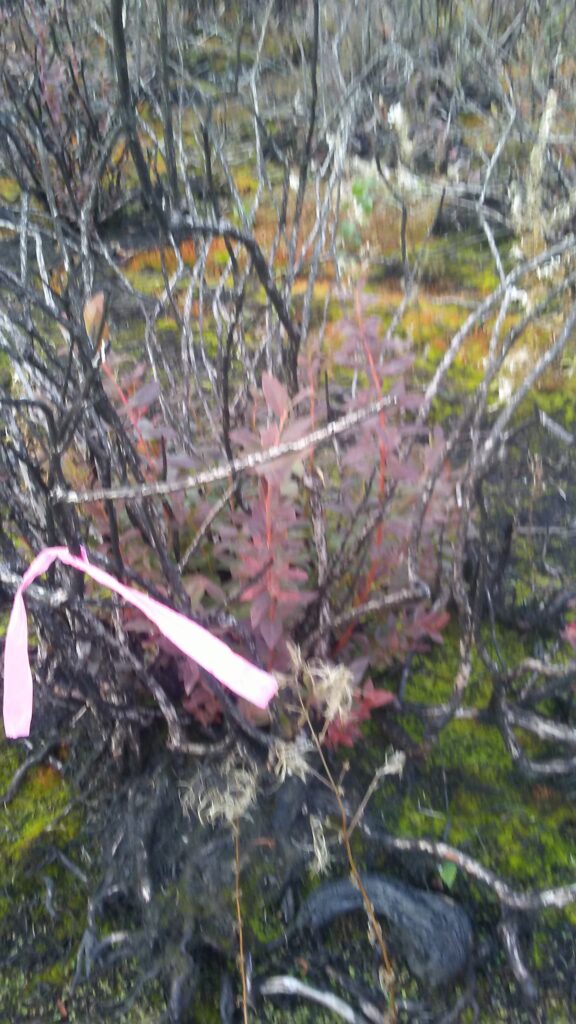
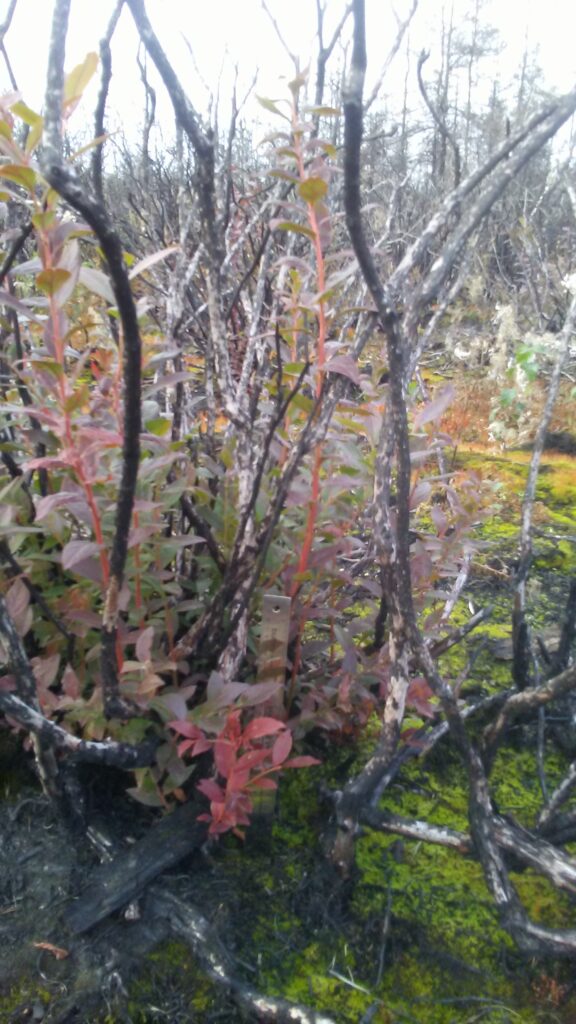
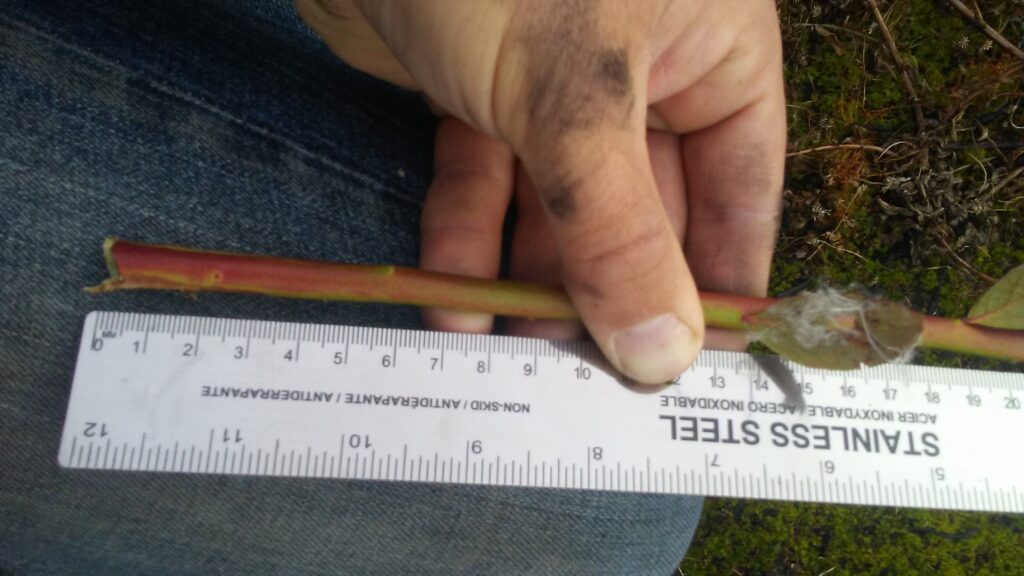
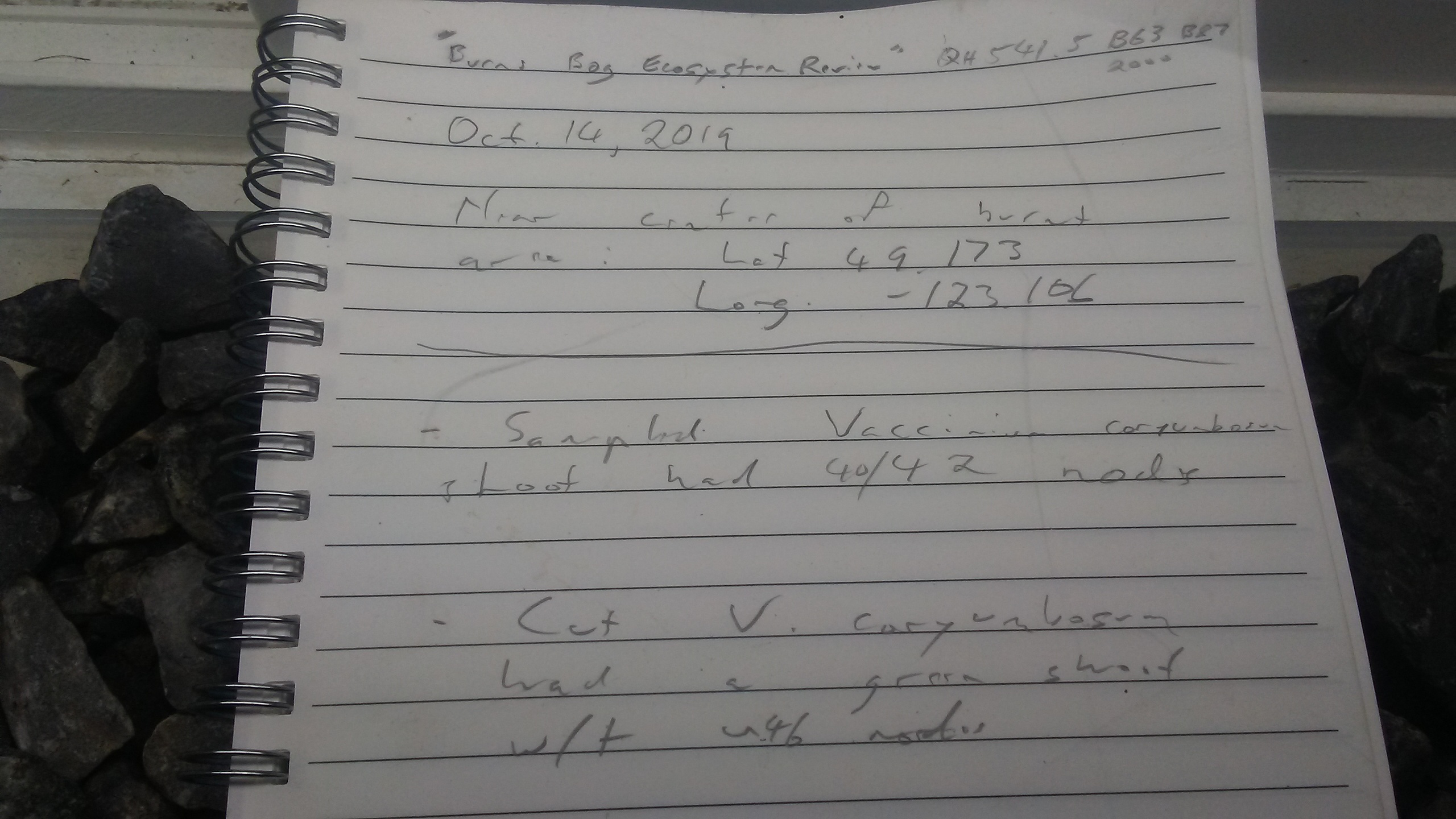
So I returned to the bog at the DND Lands on October 14th, 2019, and made some observations. According to the time stamp in my photos, the time was 5:35pm. Through out the areas that still had residual suit and char, many V. corymbosum plants, who’s canopies had been destroyed, but who’s crowns had not been damaged, showed obvious signs of vigorous greens growth, little to none of which had lignified, or only had very little newly lignified tissue at the bases of the new stems. I also took photographs of this growth, to show that there could only have been a single season’s growth since the last fire, and that fire must have occurred in the areas I will be making my observations.
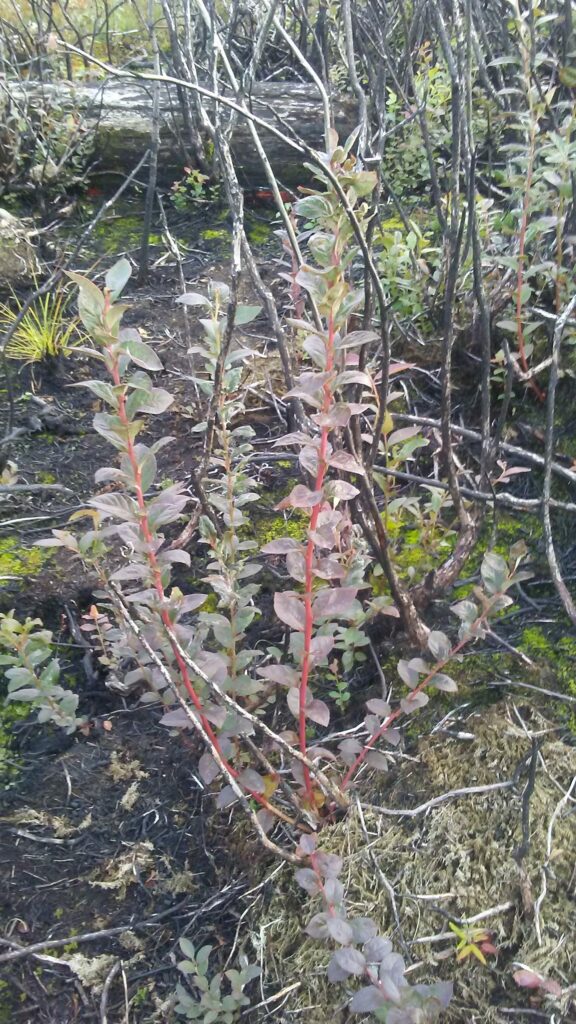
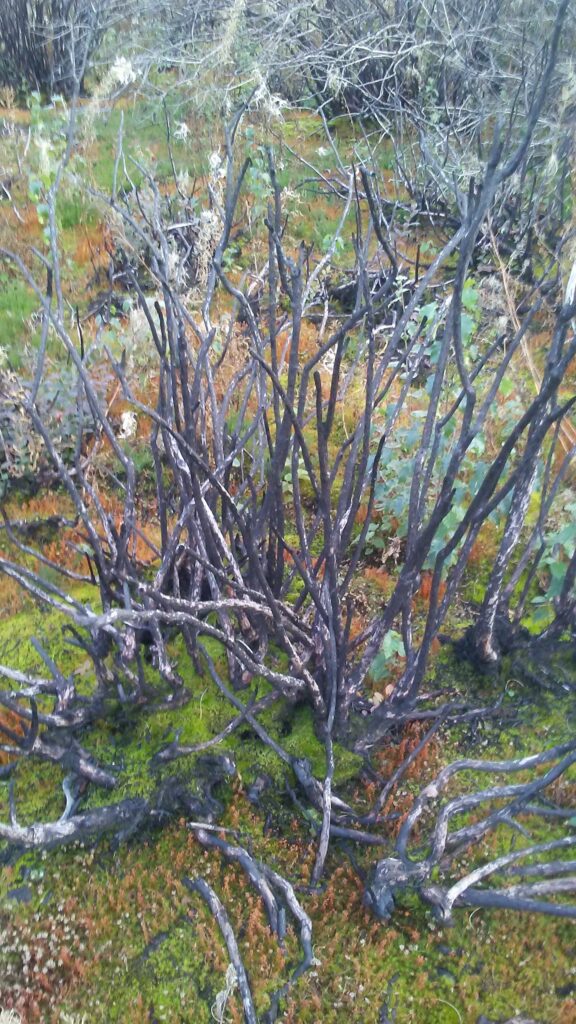
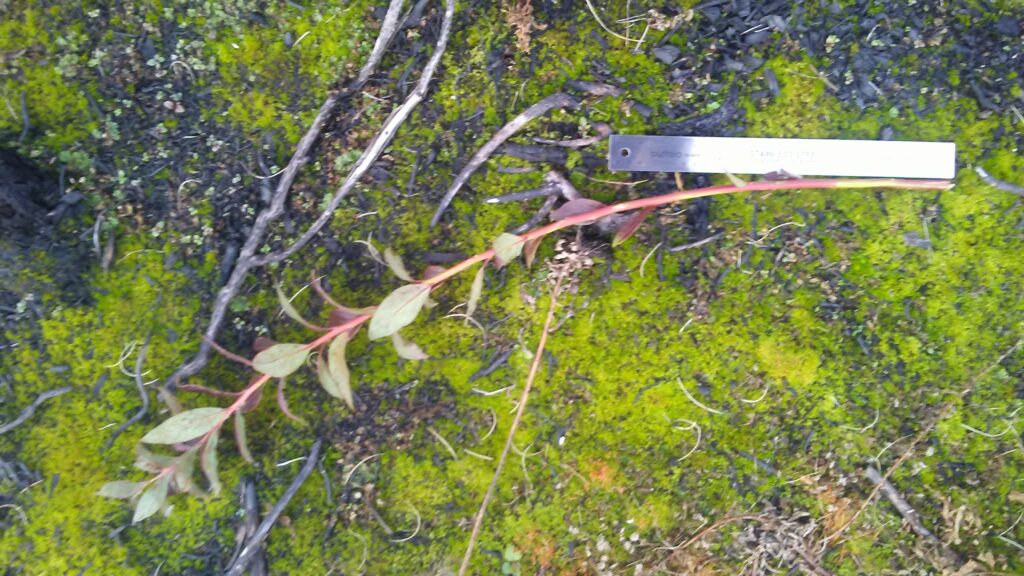
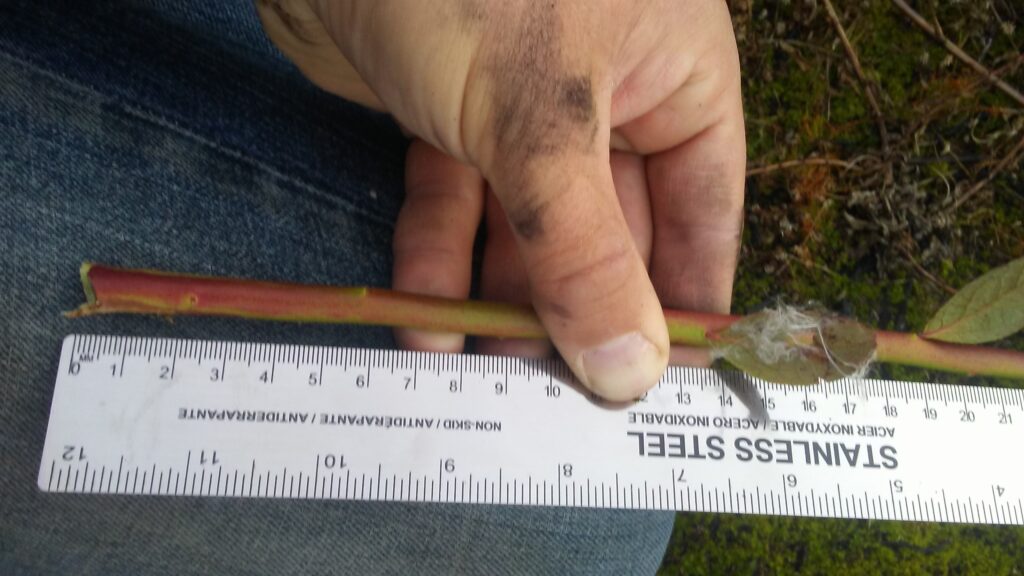
In the fifth picture I photographed the branch to be sampled while still attached to the original plant. According to my notes, the branch sampled had 42 nodes. If you can see the foot long ruler under the burnt blueberry bush, you’ll see that the branch is about three times longer than the ruler, so the branch had grown roughly a meter in one growing season. This may seem like a lot of growth, but many species of plants exhibit this response to having their canopy’s destroyed, especially ericacasious plants. In both the fifth, sixth, and seventh photos, we can see that the entire branch is composed of new, green tissues, and has virtually no lignified materials. Given the reports of fire in this area from last year (2018), the obvious evidence of recent fires in the immediate area (black suit, blackened peat, chard woody material, clearly visibly in all the photos) and the evidence of a single season’s worth of growth in the V. corymbosum plants, we can conclude with relative confidence that there was a bog fire in the summer of 2018 within the DND Lands, and, more importantly,  in the areas where I will be observing plant fire responses.


Blog Post 5: Design Reflections

Although my data collection may be more straightforward then other studies that involve in depth measurements and larger study areas, I still found I had some difficulty solidifying my study areas. Due to the fact the pond I am studying is irregularity shaped it was difficult to create study areas that were the exact same area and consistent with one another (i.e. similar amount of grassed area, pond water depth, etc). I used air photos and online mapping tools to create a rectangle surrounding the pond and then divided the rectangle evenly in four. The quadrants were divided by direction which was one pro as that is consistent, NW, NE, SE, SW and will be utilized as a variable. I found it difficult to conduct accurate population density of the species by counting for the heavily populated species since it was difficulty to differentiate between individuals and keep track, to counteract this I decided to create a range rather than an exact number. This may be subjective and difficult to confirm accuracy, so I repeated this population count once a week for 8 weeks. There was little to no variation between each visit, especially with mature vegetation like trees. However, I also believe this information is bias to the current season being fall compared to obviously Winter, Spring and Summer. I am confident supplementary research will assist me in supporting my data and I look forward to research pond management and diversity further.

Blog Post 2: Sources of Scientific Information

Preliminary citations:

Davis, Neil, Rose Klinkenberg, and Richmond Nature Park Society (B.C.). Ecology Committee. A Biophysical Inventory and Evaluation of the Lulu Island Bog, Richmond, British Columbia. Richmond Nature Park Society, Richmond, B.C, 2008.

The PDF version of this study can also be found at: https://www.richmond.ca/__shared/assets/Lulu_Island_Bog_Report48892.pdf

Comments:

This particular publication goes into great detail about the flora of Lulu Island Bog, as well as fauna, endangered species, hydrology, effects of fire, soils, etc. It was authored by multiple authors, many are experts in their fields, including a number of professors. It was edited by Brian Klinkenberg, O.L.S., M.Sc., Ph.D., and is an Associate Professor of Geography at the University of British Columbia, and Rose Klinkenberg, who graduated from the Ecology and Field Biology program at the University of Toronto. Each section and chapter of the report deals with different aspects of bog ecology, and provide introductions, methodologies, results, discussion and conclusions, along with extensive in-text citations and bibliographies.

Of particular interest is the fact that this report states that the effects of fire in the Lulu Island Bog have not been well documented and require further study (pg. 248). It also makes mention of Scotch heather as an invasive species that responds with increased vigor after bog fires have occurred (pg. 96). So it may look as though looking at the intersection of bog fire effects, and the invasiveness of Scotch heather may be a relevant and timely aspect of this bog’s ecology to focus on, especially seen as how it just experienced fire last year, and has had one years worth of regeneration since.

Blog Post 5: Design Reflections

Reflecting upon my data collection, I did have some difficulties. A common, recurring issue that I encountered was human disturbance.  To address this, I moved to a spot approximately 40 km from my home, located at the confluence of the Peace and Halfway Rivers. Eventually this area also became subject to significant recreational and industrial activity.  This ultimately led me to cut my study short (e.g., 9 instead of 10 visits).  Fortunately, I was able to collect a breadth of data.  Looking at the data, it was somewhat surprising to see that certain species tended to be observed each visit but in relatively distinct strata within the overall study area (e.g., riparian area, floodplain, open water).  If my study area had not become as subject to human activity, I would have changed my approach.  I would have used the data that I gathered to pilot a study with a more focused approach both spatially (e.g., larger number of transects in each strata) and temporally (e.g., specific times of day over a shorter period) and probably focused on a single species.  However, the repeated transect data that I collected will serve me well in small scale stratified study of occupancy.  Further, I am still able to include hydrometric data as a variable in the analyses.

BLOG POST 8

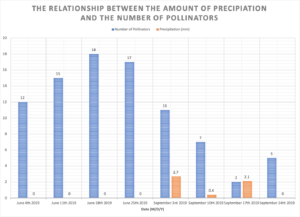
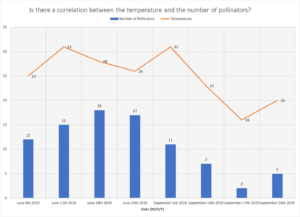
So far I have made two graphs:

  1. The correlation between the number of pollinators and the temperature
  2. The relationship between the number of pollinators and the amount of precipitation (mm)

I think both of these graphs are perfect for showing my data that I have collected. I think my data is all normal, obviously it would be better had I recorded data for a longer period of time.


BLOG POST 7

My main focus has been if there is a correlation between the number of pollinators and the weather. I have done this at a garden that has plant species that are to attract bees, therefore in theory there should be a fair number of bees in this general area. This can also tie in with the temperature of the day, the humidity, the wind, there are honestly all kinds of other factors that can affect the results. I am taking the temperature of the day and the type of weather into consideration when I am counting the number of pollinators in/ near the garden.

Three keywords for my research could be pollinators, botanical gardens, weather.

BLOG POST 6

I did eight replicates in total, all at the Bee Garden outside of the Ken Lepin building. I have had some issues with the spread-out area, with there being a fair amount of plants to keep my eye on and trying to ensure I do not miss any bees. I have noticed some slight patterns, such as there being a fair amount of bees the higher the temperature and with a lower temperature and rain there seems to be fewer bees.

Blog Post 8: Tables and Graph

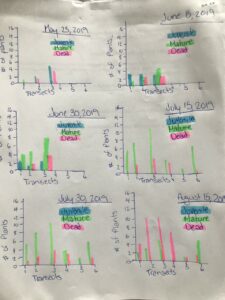
I had no issues organizing my data. I began by creating 6 tables (1 for each site visit) and have the total number of plants found in each Transect and if they were juvenile, mature, or dead plants. Once I had this information down in organized tables it was much easier to create bar graphs of our findings. I have attached 1 table and a graphical representation of all 6 site visits and their findings. I was surprised of my findings in transects 4-6 during site visits 1-3. This is because Heracleum mantegazzianum is a very strong plant and can handle all sorts of conditions, hense why it has been so successful as an invasive species in North America. But as this is the furthest North it has began to reach in British Columbia, the chances are it just has not made it to the denser forest and higher altitudes at this time. 

Transect  Juvenil  Mature  Dead 
T1  0  1  0 
T2  3  0  2 
T3  6  0  4 
T4  0  0  0 
T5  0  0  0 
T6  0  0  0 
Total Mean  1.5  0.2  1 

(Table 1 – results of plants found on May 25th, 2019. Transect 1-3 are within Section 1 (disturbed sites) and Transects 4-6 are within Section 2 (natural site)).


Post 7: Theoretical Perspectives

My study examines the effect of sunlight exposure on density of Canada goldenrod (Solidago canadensis). I hypothesized that higher levels of light exposure would be better growing conditions for the goldenrod, and therefore would result in increased plant density. As such, my research primarily relates to the goldenrod’s germination process and its preferential growing conditions. Additional factors that will be considered are the effects of soil moisture, elevation, and competition with other vegetation.

Three Keywords: Sunlight exposure, plant density, Solidago canadensis