Blog Post 5: Design Reflections

Did you have any difficulties in implementing your sampling strategy?
If yes, what were these difficulties?
-Yes, the peatlands where I planned on gathering data were either flooded, or snowed over, making finding either Scotch heather or cranberry plants a challenge. The conditions have improved, however, and I returned last weekend to begin collecting data, again.

Was the data that you collected surprising in any way?
-Not really, however, I only collected one quadrats worth of data. I collected data from within the burn zone. The quadrat only contained Scotch heather (Calluna vulgaris), and it was present with 75% of the cells within a 1m^2 quadrat with 10cm^2 cells.

Do you plan to continue to collect data using the same technique, or do you need to modify your approach? If you will modify your approach, explain briefly how you think your modification will improve your research.
-My basic method of gathering data using the above mentioned quadrat will not change. However, I may change the strings in the quadrat for wires.

Also, after studying experimental design for a few weeks this semester at my own university, I have decided to make some changes to how I will design this study. I have laid my observational study as follows:

The general design format will stratified random sampling, and the the statistical analysis I will use will be based on this design. I will use Jamovi for the analysis.

The burnt area of the bog in the DND lands will constitute one sampling strata, and the unburned area around it, delineated by a square boundary, will constitute the other sampling strata. Each strata contains 10 samples, selected randomly by drawing lots (separately and independently for each strata).

After I drew these lots for each strata, I used a web application (Earthstar GeoInformatics) to figure out where these samples would be found using longitude and latitude. I generated the map shown below:
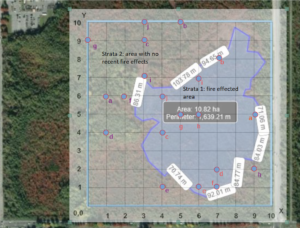
Here are the coordinates for the sample locations, and notes on how I calculated their positions:

Strata 1:

a latitude 49.17356 N longitude 123.10890 W
b 49.17538 123.10638
c 49.17493 123.10764
d 49.17265 123.10890
e 49.17129 123.10700
f 49.17356 123.10827
g 49.17493 123.10954
h 49.17175 123.10385
i 49.17402 123.10764
j 49.17538 123.10764

Strata 2:

a 49.17311 123.10385
b 49.17447 123.10512
c 49.17265 123.10701
d 49.17175 123.10511
e 49.17129 123.10574
f 49.17129 123.10511
g 49.17311 123.10638
h 49.17311 123.10575
i 49.17357 123.10512
j 49.17356 123.10701

I will use my smart phone to find each sample location.

Null hypothesis: there is no correlation between the effects of bog fire, and the presence of Calluna vulgaris and Vaccinium oxycoccos within the DND lands bog.

Alternate hypothesis: there is a correlation between the effects of bog fire and the differences in presence of C. vulgaris and V. oxycoccos, if any such difference can be observed, within the DND lands bog.

The statistical analysis I will use is summarized on this Oregon State University website. I will also be do an analysis to test for correlation between percent presence of both Calluna vulgaris, and Vaccinium oxycoccos within the burnt and unburnt strata. The presence of either species is measured by species present or not present in each cell within the quadrat, each quadrat having 100 x 10cm^2 cells.  If a species is present within the cell, this is simply considered a tally of one, for presence within cell. Both heather and cranberry could potentially be counted as present in the same cell, or they could not.

However, I’m not sure yet if Jamovi can already do this, so after doing more data collection tomorrow, I will be exploring what options that software has, and if it doesn’t, I’ll have to decided to either create a module myself, and to simply work through the mathematics myself. I should have a large chunk of my data for strata 1 collected before the weekend, and hopefully have Jamovi figured out by the end of this coming weekend.

Regardless of what modules Jamovi currently has, the sampling design I will use is what I just described, and the analysis will follow the Oregon State web page as my outline for analysis. I’ll go over this in greater detail in a future post.

Blog 7: Theoretical Perspectives

Blog Post 7: Theoretical Perspectives 

In considering the patterns and productivity of fauna that predominate on two separate gradients of differing exposure to ocean climate, the diversity of the vegetative species may reflect a relationship with their environment through analysis of the piece, the soil matrix. Each gradient undergoes the consistent disturbance of winter storms that bring strong winds, large waves and heavy rainfall. An inventory of the flora might give insight towards competitive success and preferred microclimates. 

My hypothesis addresses processes of ecological disturbance through sodium ion flux influenced by environmental dynamics. These abiotic factors have extenuating contributions from rainfall and average temperatures that are not of the main focus of this study, however, are under consideration in discussion. Competition and disease may also be contributing biotic factors that are not addressed in the hypothesis, yet may be of considerable association. Statistical data is being compiled to consider resulting deductions on community structure and complexity. The frequency of storm disturbance is thought to be of primary impact on the electroconductivity of the microclimates and soil matrix from which the diversity of vegetation is based. 

 E. Carmen Bell

Blog 6: Data Collection

Blog 6: Data Collection 

On January 21, 2020, the West coast of Vancouver Island was at the tail end of a typical winter storm. The morning had seen winds of up to 33km/hr and Environment Canada expectations were 20mm of rainfall. This is not unusual, however, it was not an ideal day for data collection. The sample unit was of soil matrixes of ten replicates. Each sample underwent three tests for total dissolved solids (TDS) taken to study the conductivity of the gradients in relation to the diversity of flora species. The ten soil samples were taken from surface to a depth of fifteen centimeters. Five samples were taken from the westernmost open ocean plot (41.1331°N, 125.8905°W) and five from the easternmost inlet plot (49.1207°N, 125.8969°W). The matrix of the soil samples may be more telling as to the biodiversity as is the electroconductivity, however, I think the data I collected will provide a reasonable clear expression of the patterns of vegetation. I will add the predominant storm patterns for this time of year to the introduction of my study and wonder if it should have been incorporated into the hypothesis. 

The following is similar to Blog #5 because I have accidentally combined the two posts.  

My hypothesis is testing soil conductivity and comparing vegetative species in quadrats placed using a systematic sampling method. I maintained random selection of sample replicates by tossing my spade towards a first sample site and then used a tape measure (predetermined distance) and a compass to sample the next four sites. For each sample site in the two gradients being compared, I placed the quadrat (0.5m x 0.5m) so that the spade was in the center and in a manner that allowed for the stems of the species of vegetation present, gently discouraging vegetation that was “leaning in”.  

The soil samples were taken from surface to a depth of fifteen centimeters. Five samples were taken from the western (open ocean) plot and five from the eastern (inlet exposure) plot. The matrix of the soil samples was as I expected, the open ocean samples being mostly sand and the inlet samples being mostly humus. At home I baked each sample in the oven at 200 degrees Celsius for four hours. I used a 1:2, soil to distilled water, to create a slurry, then followed the same procedure for testing the concentration of total dissolved solids for each of the ten samples.  

Because both regions being sampled had very little differentiation, there was no need to create subareas, therefore I did not use the stratified random sample method. Instead, I used a systematic sampling method to transect the sample region, the sample sites spaced in proportion to representation of the gradient, a method that if replicated would yield samples that were also indicative of the region. The data I have collected has demonstrated completely opposite results from the position of my hypothesis. In the name of science, I will not change anything but I will explore why this is so in the discussion portion of my study. 

E. Carmen Bell

Blog Five: Design reflections

Blog Five: Design Reflections by E. C. Bell 

My hypothesis-in-the-works has shifted towards considering the soil with the highest degree of salt to have the least amount of vegetative diversity. As a result, my sample unit has become the soil in relation to flora species and visible attributes. I maintained random selection of sample replicates by tossing my spade towards a first sample site and then used a tape measure (predetermined distance) and a compass to sample the next four sites. For each sample site in the two gradients being compared, I placed the quadrat (0.5m x 0.5m) so that the spade was in the center and in a manner that allowed for the stems of the species of vegetation present, gently discouraging vegetation that was “leaning in”.  

The soil samples were taken from surface to a depth of fifteen centimeters. Five samples were taken from the western (open ocean) plot and five from the eastern (inlet exposure) plot. The matrix of the soil samples was as I expected, the open ocean samples being mostly sand and the inlet samples being mostly humus. At home I baked each sample in the oven at 200 degrees Celsius for four hours. I used a 1:2, soil to distilled water, to create a slurry, then followed the same procedure for testing the concentration of total dissolved solids for each of the ten samples.  

Because both regions being sampled had very little differentiation, there was no need to create subareas, therefore I did not use the stratified random sample method. Instead, I used a systematic sampling method to transect the sample region, the sample sites spaced in proportion to representation of the gradient, a method that if replicated would yield samples that were also indicative of the region. The data I have collected has demonstrated completely opposite results from the position of my hypothesis. In the name of science, I will not change anything but I will explore why this is so in the discussion portion of my study.

Carmen Bell

Blog post Four:

Community Sampling Exercise by Carmen Bell 

 Community: Snyder-Middleswarth Natural Area 


The three virtual sampling strategies used to assess species density for the Snyder-Middleswarth Natural Area included random, systematic and haphazard. Of the three, the area-based haphazard sampling method was the fastest at 12 hours, 12 minutes, likely because these are known representations of the larger area taken in a non-random manner. The longest duration was the area-based random or systematic method of 12 hours, 45 minutes. The difference in time between the two is not vast for the 24 plots, however, the difference may increase given more sample points.  


1. Area, random or systematic  2. Area, random or systematic  3. Area, haphazard 


12 hours, 35 minutes  12 hours, 45 minutes  12 hours, 12 minutes 


For the total area of the Snyder-Middleswarth Natural Area, 24 sample points were not enough to represent the diversity of the 200ha old-growth hemlock-yellow birch forest. In effect, each sample point represents 8.3 hectares (20.6 acres) over the steep terrain of a ravine created by the Swift Run River. As this is a virtual exercise, the representation can only be imagined. In a real case scenario, the accuracy represented in the sample points would depend, in part, on the variation of soil composition within the degrees of steepness. 


My assessment of the histograms from a perspective of relative species abundance, determined that the Eastern Hemlock and Sweet Birch be considered common, while the remaining species be considered rare. Within the context of biodiversity, “…, n individuals usually fit a hollow curve, such that most species are rare … and relatively few species are abundant” (McGill, et al., 2007). Each of the Yellow Birch, Chestnut Oak, Red Maple, Striped Maple and White Pine had a relatively hollow curve given the limited data. The Snyder-Middleswarth Natural Area is known as an old-growth hemlock-yellow birch forest. The lower density of yellow birch could be attributed to the larger stem size of an old growth tree. 

Considering the Eastern Hemlock and Sweet Birch as the most common species, the most accurate density reading was the Eastern Hemlock with a 10.6 percentage error between the known and sampled data. Considering the Yellow Birch, Chestnut Oak, Red Maple, Striped Maple and White Pine species as rare, the most accurate density reading lay with the Striped Maple at 14.3% error. I would like to point out that only 20 trees were sampled with a known density of 17.5. The Yellow Birch had a higher percentage of error at 30.2, however, the known density is 108.9 with 76.0 represented in sample data, demonstrating a stronger representation of the species.  


Eastern Hemlock

                 Actual   Data

Density  469.9  520.0 


520.0 – 469.9 / 469.9 x 100 = 10.6% percentage error 


Sweet Birch  

Actual   Data

Density  117.5  188.0 


188.0 – 117.5 / 117.5 x 100 = 60.0% percentage error 


Yellow Birch

Actual   Data

Density  108.9  76.0 


76.0 – 108.9 / 108.9 x 100 = 30.2% percentage error 


Chestnut Oak

Actual   Data

Density  87.5  36.0 


36.0 – 87.5 / 87.5 x 100 = 58.9% percentage error 


Red Maple  

Actual   Data

Density  118.9  152.0 


152.0 – 118.9 / 118.9 x 100 = 27.8% percentage error 


Striped Maple  

Actual   Data

Density  17.5  20.0 


20.0 – 17.5 / 17.5 x 100 = 14.3% percentage error 


White Pine

                 Actual   Data

Density  8.4  0.0 


0.0 – 8.4 / 8.4 x 100 = 100% percentage error 


Post 5 – Design Reflections

My initial data collection was not difficult.  The plot locations were easy to get to other than the 20cm of snow that was unpleasant, but otherwise the terrain is very accessible.  The data collected showed that there were actually very few regenerating cottonwood stems, which at first glance, I thought there would be substantially more.  There were also less coniferous species found than expected, but this could also be due to the fact that small stems are under the snow, or have been browsed.  The amount of woody shrub cover can make plots difficult, as there are a lot of plants to maneuver around.   The only modification I may make is increasing plot size from a 3.99 meter radius (50 meters squared) to a 5.64 meter radius (100 meters squared).  This could improve the accuracy of the estimated density of tree species, as a larger plot may pick up more species, improving the estimated density.  It may also be helpful to actually count the number of shrub species in the plot as opposed to estimating their percent (%) cover, as these plants could be the main reason as to why there are very few coniferous species establishing in the area.

Blog Post 1: Observations

The study area I have chosen is Central Park on Denman Island, BC, Canada. Central Park is located in approximately the middle of the Island. Central Park is ~147 acres in size and contains two large wetlands and a recovering forest after years of logging in the area. It was logged by horses in 1998 and then heavily logged in the year 2000. The forest is specifically a Coastal Douglas-fir. This kind of forest is relatively rare in B.C. and is threatened. Local conservationists have identified up to 64 different birds that have been spotted in this park.

I visited this area first on June 24th, 2019 between 6:28 and 7:37 PM. On this day the weather was observed to have a low of 12 degrees C and a high of 19 degrees. It was sunny with clouds.

While on this walk I noticed 3 interesting potential study areas with the local ecology:

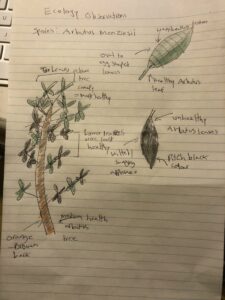
1.) Some but not all arbutus trees appeared to be dying or suffering from some ailment. Some trees had dark covered bark and leaves, while others had very little or no sign of damage. Arbutus are known to shed leafs and bark at various times in the year, but my observations were outside the normal leaf shedding. Why were some of these arbutus trees affected but not others, and why were some of them dying?

2.) In some areas ovate shaped leaves appeared covered in small holes. What organism or local weather or climate caused these holes in these particular areas?

3.) In some areas of the forest and meadows, there appeared to be large concentrations of thistle plants (dozens in a small parcel of land). Why were there so many thistle species in such a small area?

Field Observations:

Blog Post 4: Sampling Strategies

The three sampling strategies I used in the virtual forest were, Distance-systematic, Distance-random, and Distance-haphazard.  The results from the three strategies were similar in that species percentages remained in order, and no strategy sampled any White Pine.

Of the three strategies I used, Distance-systematic had the fastest estimated sampling time at 4hrs 16min, followed by Distance-random at 4hrs 30min. The slowest estimated sampling time belonged to the Distance-haphazard strategy, at 4 hrs 49min.

Species: 

Eastern Hemlock(EH), Yellow Birch(YB),Striped Maple(SM), White Pine(WP)

%Error/Strategy:

Systematic: EH:15.06%, YB: 97.33%, SM: 17.14%, WP: 100%

Random: EH: 0.17%, YB 1.56%, SM: 56.01%, WP: 100%

Haphazard: EH: 1.92%, YB: 35.45%, SM: 5.14%, WP: 100%

As can be seen, the accuracy varied between species abundance in the different sampling strategies. As per my virtual forest survey, it can be assumed that species does not affect accuracy. The only consistent % error was with White Pine, which was not sampled in any of the three strategies I used, and therefore had a % error of 100%.

The least accurate of the strategies was Distance-systematic, while the other two were fairly similar in their accuracy.

Post 6: Data Collection

My original hypothesis stated that the abundance of dandelions in the centre field of General Brock Park in Vancouver, BC was dependent on their proximity to areas of human activity.

I recently went to do some observations but the dandelions were gone, leading me to modify my hypothesis. I counted the abundance of English daisies (Bellis perennis) as well as other flowers instead.

With the help of my brother, I counted the number of English daisies, red clovers, white clovers, and dandelions in five 1m x 1m quadrats placed randomly in General Brock Park. I did not have any problems implementing my sampling design.

Blog Post 4: Sampling Strategies

Which technique had the fastest estimated sampling time?: Haphazard was the fastest.

Compare the percentage error of the different strategies for the two most common and two rarest species.: both were right skewed, however haphazard sampling resulted in less error dispersion, where as random sampling showed a clearer dispersion of error. Seen as how they both skew in roughly the same way, I would conclude that random sampling is accurately representing possible error, where as haphazard may be showing a tendency to show false positive.

Further thoughts: It may also be that with a right hand skew, plus less diffuse error distribution in the haphazard model may actually be a fat tail. If this is the case, then some very important outliers could be hiding in that tail. On second thought, I don’t think I’d want to use this sampling technique where missing the effects of outlying, or phenomenon could have a major impact on stake holders involved in decision making. I wouldn’t use this in helping with ecological assessments around environmental safety, conservation issues regarding extremely endangered species, or economically and culturally vital species, such as salmon or herring populations. If there is error, the randomized model seems represents it more effectively, with a more dispersed deviation around the mean, there by prevent the right skew kurtosis.

Did the accuracy change with species abundance?: No, it didn’t seem to. Although, this may reflect the fact that when I sampled in haphazard sampling, I followed a pattern, and did not attempt to emulate a random pattern. I may have to try sampling again.

Was one sampling strategy more accurate than another? I believe so. I think random sampling shows a more accurate distribution of the deviation. However, haphazard is faster, and easier. If the errors in haphazard are predictable, and can accounted for, it may still be appropriate under certain circumstances.